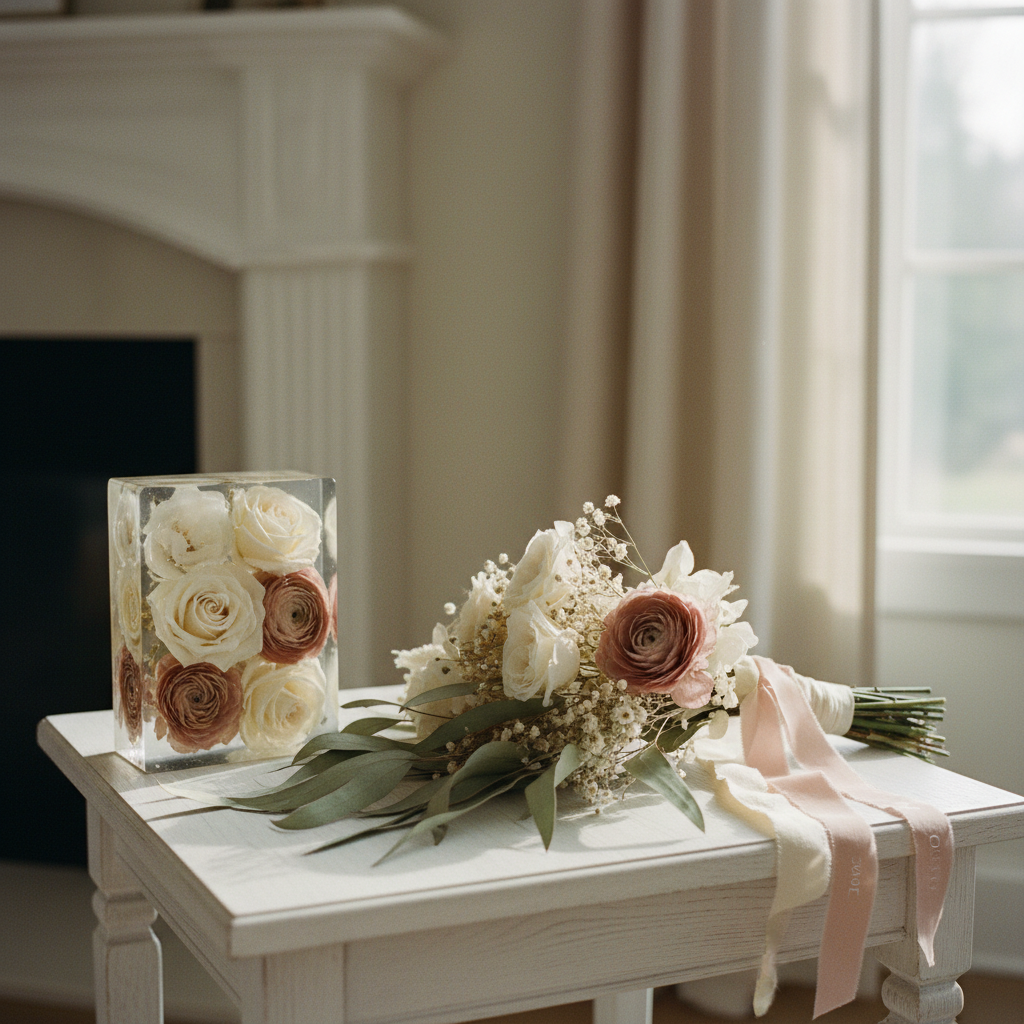
You walked down the aisle with that bouquet in your hands. Then the last dance ended, and the flowers started to fade. Watching them wilt feels like losing a small piece of the best day of your life.
Here’s the good news. You don’t have to let them go. Preserving your wedding bouquet turns a few days of fresh flowers into a keepsake you keep for decades. It becomes a daily reminder of the moment you said yes.
This guide covers both paths: do it yourself at home, or hand your blooms to a pro. We walk through every step and every cost, so you can pick what fits your budget and your timeline.
| Service | Primary Method(s) | Starting Cost | Average Turnaround |
|---|---|---|---|
| Bart’s & Crafts | Resin casting & keepsakes | Starting at $95 | 8-12 weeks |
| The Pressed Bouquet Shop | Flower pressing & framing | ~$500+ | 4-6 months |
| Timeless Gardens | Freeze-drying & display cases | Varies by project | 4-8 months |
| Flora-Ly | Resin casting | ~$400+ | 12-16 weeks |
| Heartwood & Co. | Resin casting | Varies by project | 10-14 weeks |
1. Bart’s & Crafts Bloom Forever
Your wedding memories should last as long as your marriage. That’s the idea behind Bloom Forever, our floral preservation service. You send us your fresh bouquet, and we turn it into a custom resin keepsake you can actually live with: a decorative block, a ring holder, bookends, and more.
You bring the vision and the bouquet. We bring the cohesion. Our team captures your flowers’ color and shape, then casts them into modern pieces that fit your home instead of hiding in a closet.
Strengths:
- Accessible pricing: Packages start at $95, so a real keepsake fits most wedding budgets.
- Modern resin art: We build contemporary pieces that read like art, not a dusty shadow box.
- Done for you: Skip the mess. We send clear instructions for getting your bouquet to our Centerville, Ohio studio, and we ship nationwide.
- Coordinated aesthetic: We style events for a living, so your keepsake can match elements from The Big Day Suite wedding package.
- Your call on the design: You pick the shape and style, so the final piece is truly yours.
2. The Pressed Bouquet Shop
The Pressed Bouquet Shop sticks to the traditional art of flower pressing. They turn wedding flowers into elegant, minimalist framed pieces. It’s a full-service experience: you book a spot ahead of time and ship your bouquet overnight right after the wedding.
Best for: Couples who love a classic, flat, framed look and want their bouquet as wall art.
Pricing: Starts around $500 for smaller frames and climbs with size and detail.
Standout features: Strong brand recognition and a distinct style, with a range of frame sizes, shapes, and finishes.
Advantages:
- Deep specialization in flower pressing.
- Produces gallery-worthy framed art.
Disadvantages:
- Long lead times, and booking spots fill fast.
- Pressing flattens the flowers, so you lose the original 3D shape.
3. Timeless Gardens
Timeless Gardens has worked in floral preservation for years, using a high-end freeze-drying method. Freeze-drying holds the original shape, size, and most of the color of your flowers. They then arrange the blooms in custom shadow boxes or glass domes.
Best for: Couples who want to keep the bouquet’s original three-dimensional shape.
Pricing: Varies by project and sits at the premium end.
Standout features: Commercial-grade freeze-drying, one of the most effective ways to keep flowers looking lifelike.
Advantages:
- Excellent at preserving original shape and volume.
- Classic, traditional display-case look.
Disadvantages:
- One of the pricier options out there.
- Finished pieces are fragile and need careful handling.
4. Flora-Ly
Flora-Ly is an artist-led studio focused on modern resin preservation. They cast bouquets into custom shapes like blocks, arches, and hexagons. First they dry the flowers, then set them in UV-resistant resin for a crystal-clear finish.
Best for: Couples who want popular resin shapes and a high-gloss finish.
Pricing: Starts around $400 and climbs with larger, more detailed pieces.
Standout features: A wide range of mold shapes and sizes, plus detailed shipping instructions for clients nationwide.
Advantages:
- Durable, long-lasting resin pieces.
- Modern style that holds up over time.
Disadvantages:
- The cost is a real investment.
- Like most resin work, turnaround runs several months.
Urgent First Steps: Preparing Your Bouquet for Preservation
DIY or pro, prep makes or breaks the result. The 24 to 48 hours after your wedding decide how good your flowers look in the end. Move on these steps right away.
- Act fast. Time works against you. Fresher flowers preserve with brighter color and stronger petals. Put one trusted friend or family member in charge of the bouquet after the reception.
- Trim and hydrate. Snip about an inch off the stems at a 45-degree angle as soon as you can. Set the bouquet in cool water so the flowers rehydrate after a long day.
- Keep it cool and dark. Store the bouquet somewhere cool and dark, like a closet or basement. A refrigerator works too, but keep it away from fruits and vegetables, which release ethylene gas and speed up wilting. Never freeze your bouquet. Freezing destroys the cell walls and ruins it for preservation.
- Ship by the instructions. With a pro service like Bloom Forever, you get exact shipping steps. That usually means lightly hydrating the flowers and packing them tight so nothing shifts in transit.
4 DIY Wedding Bouquet Preservation Methods Compared
Want to make your own keepsake at home? The right method depends on the look you want, the tools you own, and how patient you are. Here are the four most popular ways to preserve a wedding bouquet yourself.
Method 1: Air Drying for a Rustic Finish
This is the oldest, simplest method. It needs no special gear and gives you a rustic, vintage look with muted colors.
How to do it: Split your bouquet into smaller bunches or single stems. Tie them with rubber bands or twine and hang them upside down in a dark, dry, well-ventilated spot like a closet or attic. The dark keeps colors from fading, and the airflow stops mold. Leave them for two to three weeks, until they feel completely dry and stiff.
Method 2: Pressing for a Flat, Framed Finish
Pressing gives you delicate, two-dimensional versions of your blooms, perfect for framing or craft projects. It works best on naturally flat flowers like pansies, violets, and ferns, but you can press rose petals and other disassembled flowers too.
How to do it: Lay individual flowers or petals between two sheets of absorbent paper. Parchment or coffee filters work well. Set them inside a heavy book like a textbook, then stack more weight on top. Press for two to four weeks, and swap the paper if it gets damp.
Method 3: Silica Gel for Color That Lasts
Want to keep more of the flower’s original color and shape? Silica gel is your best DIY bet. Despite the name, it’s a sand-like substance that pulls moisture out fast, and you can grab it at most craft stores.
How to do it: Find an airtight container big enough for your flowers. Pour a one-inch layer of silica gel on the bottom. Set your flowers on top, facing up. Slowly pour more gel around and over the petals, working it between the layers without crushing the bloom. Cover the flowers completely, seal the container, and wait about a week. Once dry, the flowers turn delicate, so lift them out carefully and brush off the crystals with a small brush.
Method 4: Epoxy Resin for a Modern Keepsake
Resin flower preservation is a more advanced project, but it pays off with durable, glass-clear results. You cast pre-dried flowers in a two-part epoxy resin to create a solid, glass-like piece.
How to do it: Dry your flowers fully first, ideally with silica gel. Any leftover moisture ruins the cure and rots the flowers. Work in a well-ventilated area with gloves and eye protection. Mix the resin and hardener per the instructions, pour a thin layer into your silicone mold, arrange the dried flowers, then slowly pour the rest on top. Pop air bubbles with a light pass of a heat gun or torch. Let it cure 24 to 72 hours, until it’s rock solid.
Common Challenges in Wedding Bouquet Preservation
Even with the right method picked out, a few worries trip couples up. Here is how to handle the three that come up most.
Will the resin turn yellow? Cheap resin ambers over time, especially in sunlight. The fix is non-yellowing, UV-resistant resin, which is exactly what quality studios pour. Ask any pro what resin they use, and keep your finished piece out of direct sun to be safe.
Shipping a one-of-a-kind bouquet. Handing your flowers to a carrier feels nerve-wracking when they can’t be replaced. A good service sends a kit with packing materials and step-by-step instructions, so your blooms arrive snug and intact. Bridal bouquet preservation works nationwide for exactly this reason.
Too many keepsake choices. Blocks, bookends, ring holders, paperweights: the options can stall you. Start with how you want to use it. A ring holder for the nightstand, bookends for the shelf, a block for the mantel. Match the piece to a spot in your home, and the decision gets easy.
How to Choose the Right Preservation Path for Your Bouquet
The choice between DIY and a pro comes down to four things: your budget, your timeline, your confidence with crafts, and the look you want. There’s no single right answer, just the one that fits you.
Tight budget and love a hands-on project? A DIY method can be rewarding, and it adds another layer of personal touch. Just be honest about the time it takes, and know the results might not be perfect. It rewards patience and a little practice.
Want a polished result with zero stress? A professional service is the way to go. The pros have the tools, the materials, and the experience to handle surprises, so your bouquet ends up a finished piece. Think of the cost as buying peace of mind and an heirloom you’ll keep for decades.
Ready to turn your bouquet into a keepsake without the DIY hassle? Take a look at our Bloom Forever floral preservation package, and let us build a modern piece that captures your big day. You handle the happily ever after. We’ll handle the flowers.
Frequently Asked Questions (FAQs)
How soon do I need to preserve my wedding bouquet?
Start within 24 to 48 hours of your wedding. The fresher the flowers, the better they hold their color and shape. If you can’t start right away, trim the stems and keep the bouquet in water somewhere cool and dark.
How much does it cost to preserve a wedding bouquet?
It depends on the method and the provider. DIY methods cost little beyond basic supplies. Professional preservation ranges widely: resin keepsakes start around $95 with Bloom Forever, while pressed-flower framing and freeze-drying often run $400 to $500 and up. Your final price tracks the size of the bouquet and the complexity of the piece.
How do I ship my bouquet for preservation?
Most national services send a kit with packing materials and instructions. You lightly hydrate the flowers, pack them so nothing shifts, and ship overnight right after the wedding. Booking ahead means your kit is ready the moment you need it.
Will my preserved flowers in resin turn yellow?
Not when the work is done right. Quality studios use non-yellowing, UV-resistant resin built to stay crystal clear for years. To protect any resin piece, keep it out of prolonged direct sunlight, which can amber lower-grade materials over time.
How long will my preserved wedding flowers last?
With proper care, preserved flowers last for years, often decades. Keep your keepsake out of direct sunlight so the colors don’t fade, and away from high humidity so moisture doesn’t set in.
Ready to bring your vision to life?
Custom event bundles, gifts, and keepsakes — coordinated, aesthetic, and made just for you.
Start your order